Introduction to Entity SEO: The Shift Towards Context and Meaning
Search engine optimization has moved a long way from the days when simply repeating a keyword could push a page to the top of Google. Today, success depends on how well content reflects meaning, context, and intent rather than just phrases typed into a search bar.
This shift is what we now call Entity SEO. Instead of focusing only on “strings of text”, Google analyses “things” – distinct concepts such as people, places, brands, or ideas – and understands how they relate to each other. For example, Google’s systems can distinguish between “Apple” the fruit and “Apple Inc.” the company, because they recognise each as a unique entity.
Google processes billions of searches each day, and entities play a key role in helping it deliver faster, more accurate, and more relevant results. For website owners, learning how to optimise around these relationships is now essential to building visibility and long-term authority.
What Are Entities in SEO?
A Clear Definition
In SEO, an entity is a distinct and well-defined concept that search engines can recognise and categorise on its own. It could be a person, a place, an organisation, an event, or even an abstract idea such as climate change or blockchain.
Unlike simple keywords, entities are stored and understood as unique nodes of information. This allows Google to connect them with other related entities and build a network of meaning that goes beyond single words.
Entities vs Keywords
Keywords are still important, but they are only strings of text that users type into the search bar. They tell Google what someone is searching for, but they do not carry meaning by themselves.
Entities, on the other hand, provide context. They help Google understand whether a user searching for “Jaguar” is interested in the animal, the car manufacturer, or even the sports team. This level of clarity is what makes entity SEO so powerful.
Why This Matters for SEO
By recognising entities, Google can resolve ambiguity and serve the most accurate results possible. For businesses, this means that optimising for entities opens the door to higher relevance, stronger topical authority, and visibility in features like knowledge panels and other enriched results.
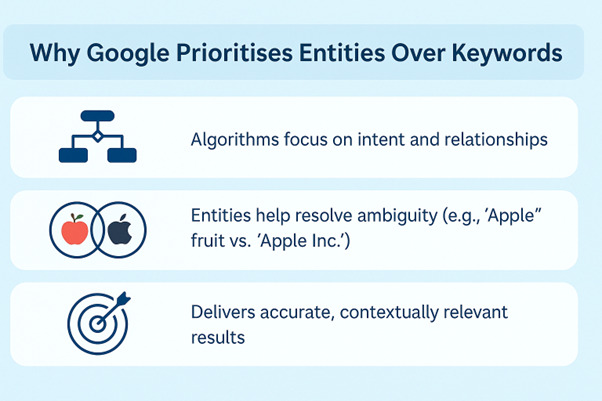
Why Google Prioritises Entities Over Keywords
From Keywords to Meaning
Google’s algorithms have advanced far beyond simply counting how many times a word appears on a page. Modern updates, powered by natural language processing and machine learning, focus on intent and the relationships between concepts. This allows Google to analyse not just what a user typed, but what they actually meant.
As a result, search is no longer about mechanical repetition of phrases. It is about context, meaning, and clarity.
Resolving Ambiguity with Entities
Entities play a central role in helping Google resolve confusion in search queries. For example, the word “Amazon” could mean the rainforest, the river, or the e-commerce giant. By recognising these as separate entities, Google can use surrounding context, user history, and other signals to identify the right interpretation.
This ability ensures that search results are tailored to intent rather than simply matching words on a page.
Delivering Relevant Results
By prioritising entities, Google is able to serve more accurate and contextually relevant results. This improves user satisfaction, reduces irrelevant results, and rewards content that provides depth and genuine expertise.
For businesses and creators, this means success in SEO now depends on aligning with Google’s entity-driven understanding of topics, not just chasing keywords.
The Knowledge Graph’s Role
A Web of Interlinked Entities
At the heart of entity SEO lies Google’s Knowledge Graph, a vast database designed to connect billions of entities and their attributes. This system does not treat data as isolated facts but links them into a network of meaning. By doing so, it gives Google the ability to understand relationships between concepts rather than analysing words in isolation.
The Knowledge Graph has been growing since 2012 and now powers much of the search experience we see today.
Strength in Relationships
For example, the Knowledge Graph can understand that a company like Tesla is strongly associated with its founder, Elon Musk, and connect these to related concepts such as electric vehicles and renewable energy. By understanding these relationships, Google can surface richer, more accurate results whenever a related query appears.
These connections allow Google to interpret searches in ways that reflect real-world understanding.
Impact on Search Experience
The Knowledge Graph fuels many of the enhanced results users now expect. Features such as Knowledge Panels and entity carousels are built directly from this structured web of entities.
While featured snippets are not powered solely by the Knowledge Graph, entity-rich content often increases the likelihood of being surfaced in these prime positions.
Benefits of Entity SEO
Building Topical Authority
Entity SEO strengthens a website’s ability to demonstrate expertise on a subject. By covering interconnected entities within a niche, content signals depth and relevance to search engines. This builds topical authority, which is a major factor in achieving higher rankings and trust from Google.
When a site consistently demonstrates knowledge across a topic cluster, it positions itself as an authority rather than just another content source.
Broader Query Coverage
Unlike keywords, entities allow your content to capture a wider variety of search queries. A single entity can be connected to dozens of related phrases and questions, meaning your content is discoverable for more variations of user intent.
This expands reach and increases opportunities to rank for long-tail and conversational searches.
Visibility in Enhanced SERP Features
Entity-rich optimisation boosts the chances of appearing in knowledge panels and other enriched results. These features not only drive higher visibility but also build credibility by associating your content with authoritative answers in search.
Aligned with Voice Search Growth
With more than half of smartphone users engaging with voice search daily, conversational queries are rising sharply. Entities help content align naturally with how people speak, making it easier for Google to match spoken questions with the right answers.
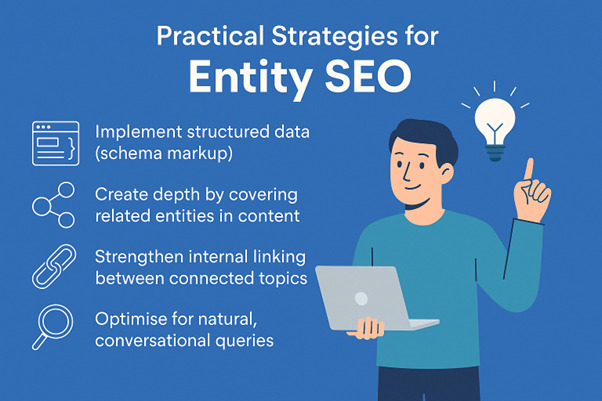
Practical Strategies for Entity SEO
Implement Structured Data
Schema markup is one of the clearest ways to signal entities to Google. By tagging people, organisations, products, and events with structured data, you provide explicit information that improves how your content is understood. This increases the chance of appearing in enriched search features and boosts discoverability.
When applied correctly, schema acts as a roadmap that guides search engines through your content with precision.
Create Depth with Related Entities
To strengthen entity recognition, your content should go beyond naming the main subject. Explore related entities that share contextual links, such as associated events, brands, or locations. This creates depth and demonstrates expertise, helping Google view your page as a reliable, comprehensive resource.
Depth matters more than surface-level mentions.
Strengthen Internal Linking
Internal links between articles and pages that cover connected entities help reinforce relationships within your site. They also improve crawlability, guiding Google to see your site as a structured network of topics rather than isolated posts.
Optimise for Conversational Queries
Voice and natural language searches continue to grow. By including question-based headings, conversational phrasing, and long-tail queries, you make your content more accessible to these search patterns. This ensures your content is aligned with how users search in real-world scenarios.
Pitfalls to Avoid
Forcing Entity Optimisation
One common mistake is overloading content with entities in an unnatural way. Search engines are sophisticated enough to detect when entities are forced rather than integrated naturally. This approach can harm readability, dilute topical focus, and signal low-quality intent to algorithms.
The best results come from weaving entities seamlessly into relevant context.
Overlooking Schema Markup
Another missed opportunity is failing to implement structured data. Without schema markup, search engines may struggle to fully understand the relationships your content is trying to establish. This not only limits visibility in enhanced SERP features but also reduces your authority compared with competitors who use schema correctly.
Schema is not a direct ranking factor, but it improves the clarity of your content and supports discoverability in enriched results.
Ignoring User Intent
Entity SEO is not just about recognition; it is about purpose. Targeting keywords without understanding why a user is searching will leave content misaligned with intent. For example, if someone searches “best electric cars,” they are seeking comparisons and advice, not a brand’s sales pitch.
Aligning content with search intent ensures that entities are presented in ways that genuinely satisfy user needs.
Conclusion
Entity SEO marks a turning point in how Google understands and ranks content. By focusing on context, meaning, and relationships rather than isolated keywords, it ensures that only the most relevant and authoritative information rises to the top.
For businesses and creators, this is both a challenge and an opportunity. Those who adapt by embracing structured data, building topical depth, and aligning content with user intent will not only gain visibility but also long-term trust from search engines.
Now is the time to evolve your SEO strategy. Move beyond keywords, invest in entities, and position your content where it belongs — at the forefront of search results.