
Why Strong Website Architecture Matters for SEO
Website architecture is the structural framework that defines how pages are organised and linked together. It shapes how search engines crawl and understand content, while also guiding users through their journey on a site. A clear and logical framework ensures efficiency, accessibility, and relevance — all essential to search performance.
For search engines, strong structure supports crawlability and indexation. For users, it ensures navigation is simple and content is easy to find. Research shows that most users leave a site if they cannot find what they need quickly, meaning structure influences both engagement and conversions.
In short, website architecture provides the foundation for long-term SEO success by supporting visibility, usability, and scalability.
How Architecture Affects Search Engines
Crawlability and Indexation
Search engines rely on crawlers to move through a website. A logical structure ensures that important pages can be reached without obstacles. By keeping navigation clear and avoiding unnecessary layers, content becomes easier to index and less likely to be overlooked.
Crawl budget — the number of pages a search engine processes during a given timeframe — is also influenced by structure. Efficient paths help crawlers cover more content in less time, which is particularly important for large sites.
Contextual Signals
Hierarchy is one of the strongest ways search engines identify relationships between content. When categories and subcategories are structured clearly, it provides context about how individual pages fit into broader topics. This improves topical relevance and supports ranking for related search queries.
Authority Flow
Internal linking distributes ranking value across a site. When links are applied strategically, authority flows naturally to the most important pages rather than being wasted on less significant ones. This strengthens visibility for high-priority content and supports balanced ranking across the site.
How Architecture Affects Users
Navigation Ease
Visitors expect simple and predictable navigation. When menus reflect a logical hierarchy, users find what they need quickly and without frustration. This consistency is especially important on mobile devices, where clarity in menus and navigation directly influences engagement.
Content Findability
Grouping related pages into clear categories helps users discover more than just the page they arrived on. By encouraging exploration, well-planned structures increase dwell time and expose users to more relevant content.
Engagement Metrics
When users can move through a site seamlessly, engagement improves. Metrics such as time on site and pages per session reflect user satisfaction. While not direct ranking factors, these signals often correlate with stronger SEO performance because they highlight relevance and quality.
Essential Structural Elements for SEO
Navigation Menus
Menus provide the core roadmap of a website. Consistency across devices ensures that both users and crawlers interpret the structure correctly.
Internal Linking
- Connects related pages together
- Reinforces topical clusters
- Passes authority to key content
Breadcrumbs
Breadcrumbs create clear trails that orient users and provide search engines with contextual signals about hierarchy. When implemented with structured data, they can also enhance how listings appear in search results.
URL Structure
- Short and descriptive
- Keyword-focused where relevant
- Easy to read and share
Sitemaps
- XML sitemaps: help crawlers discover and prioritise content
- HTML sitemaps: provide secondary navigation for users
Best Practices
Plan for Scalability
Websites should be designed to grow without creating structural confusion. Planning scalability avoids clutter and maintains consistency as more content or products are added.
Keep Click Depth Minimal
Pages should be accessible within a small number of clicks from the homepage. While there is no strict rule, shallower structures make content easier to reach for both users and crawlers.
Audit Regularly
Routine audits help spot:
- Orphan pages
- Broken links
- Redirect chains
Fixing these ensures authority flows effectively and all content remains accessible.
Optimise for Mobile Navigation
With mobile searches now dominant, navigation must function seamlessly across devices. This not only improves user experience but also supports mobile-first indexing.
Common Pitfalls to Avoid
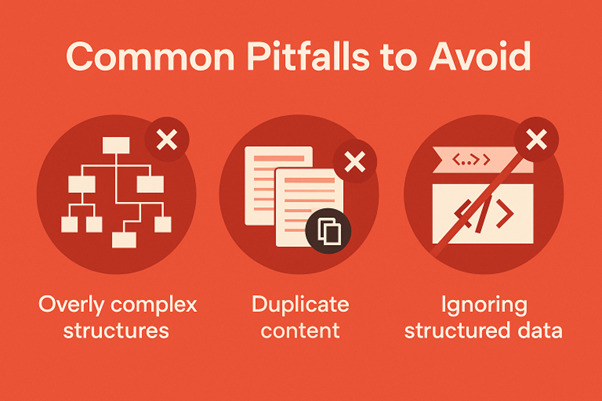
Overly Complex Structures
Deep or unclear structures make it harder for crawlers to access important pages and frustrate users. Simplifying navigation ensures better coverage and satisfaction.
Duplicate Content from Poor Categorisation
Unclear categorisation can lead to duplicate or near-duplicate content across multiple sections. This confuses search engines and dilutes ranking potential. To avoid this:
- Keep categories distinct
- Assign pages logically
- Regularly review site taxonomy
Ignoring Structured Data
Neglecting structured data for navigation and breadcrumbs limits a site’s potential to send hierarchy signals to search engines. Implementing it correctly increases eligibility for enhanced search results and clarity.
Conclusion
Website architecture is not simply a design choice — it is the backbone of SEO performance. A clear and scalable structure helps search engines crawl, index, and rank content effectively, while guiding users through smooth and intuitive journeys.
From clean navigation and internal linking to structured data and sitemaps, every element plays a part in shaping visibility. Avoiding pitfalls like complexity, duplication, and missing structured data ensures a site remains efficient and competitive.
By treating architecture as a strategic priority, websites can achieve sustainable SEO growth, stronger user engagement, and long-term digital success.
FAQs
Because it determines how easily search engines crawl, index, and understand your content, while also shaping user journeys.
Shallow structures perform better. Aim to keep pages accessible in a few clicks from the homepage.
It passes authority to key pages, connects related content, and strengthens topical relevance.
Deep structures, duplicate content, and missing structured data are the most damaging.
Sitemaps do not guarantee rankings, but they help search engines discover and index content more effectively.


