
Introduction: AI Adoption for Service-Based Businesses in Singapore – Where Should You Start?
Artificial intelligence (AI) is becoming an increasingly useful tool for businesses in Singapore. From answering customer enquiries to preparing marketing content and handling administrative tasks, AI offers opportunities for service-based businesses to improve their daily operations.
According to the Infocomm Media Development Authority’s (IMDA) Singapore Digital Economy Report 2026, AI adoption among small and medium-sized enterprises (SMEs) increased from 14.5% in 2024 to 23.4% in 2025. This reflects the growing use of AI among Singapore businesses.
However, many business owners are still unsure where to begin. Do you need expensive software, technical expertise or a complete change to your existing business processes?
Not necessarily. For most service-based businesses, successful AI adoption starts with identifying everyday problems and finding practical ways to solve them.
What Does AI Adoption Mean for Service-Based Businesses?
AI adoption means introducing software with artificial intelligence capabilities into everyday business activities. These tools can assist employees with completing tasks, organising information, preparing documents and managing routine work.
For service-based businesses, this could involve using AI to draft customer emails, summarise meetings, prepare marketing materials or answer frequently asked questions.
However, there is an important difference between AI assistance and automation.
Some AI tools help employees prepare information, generate suggestions or complete tasks more efficiently. Others can perform certain activities automatically when properly configured and connected to existing business systems.
Adopting AI does not necessarily mean replacing employees or removing the personal service that customers value. The objective is to use technology where it adds practical value while keeping people responsible for important decisions and customer relationships.
Step 1: Identify Where AI Could Help Your Business
Before exploring AI software, take a closer look at how your business currently operates.
Review Your Existing Business Processes
Start by identifying activities that take up considerable time each week.
For example, employees may repeatedly answer similar customer questions, prepare routine documents or manually organise appointment information. Although these activities are necessary, some may be suitable for AI assistance.
Consider asking your team which tasks are repetitive, time-consuming or frequently delayed.
This helps you identify actual business needs instead of adopting technology simply because it is becoming popular.
Focus on Problems That AI Can Realistically Solve
Not every business activity requires AI. Begin with tasks that are clearly defined, relatively low-risk and easy to evaluate.
For example, a tuition centre in Singapore may receive numerous enquiries about class schedules, course fees and available programmes. An AI-assisted enquiry system could help answer common questions while directing more complicated requests to employees.
This would be a more practical starting point than immediately investing in a complicated customised system.
The priority should always be solving a business problem, not simply finding a reason to use AI.
Step 2: Explore Practical AI Applications for Service-Based Businesses
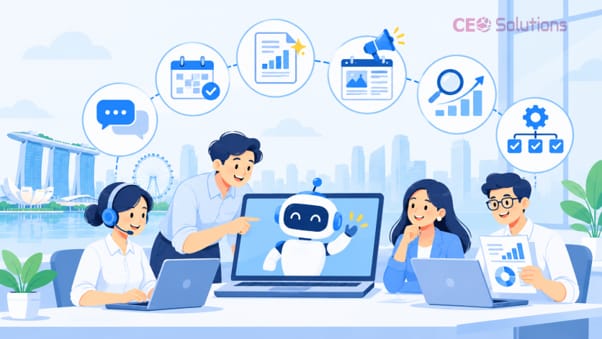
Once you have identified areas for improvement, the next step is understanding how AI could support those activities.
Different service industries have different requirements, but several applications are particularly relevant to smaller businesses.
Customer Enquiries and Communication
Businesses that receive frequent customer questions may benefit from AI-powered chatbots or AI-assisted messaging tools.
These systems can help answer routine enquiries about operating hours, available services, appointments and general procedures.
AI can also assist employees in preparing email responses, allowing them to spend more time handling enquiries that require personal attention.
However, businesses should ensure customers can reach an employee when questions are complicated, sensitive or beyond the AI system’s capabilities.
Administrative Tasks and Daily Operations
Administrative work can take up a significant portion of an employee’s working day.
AI tools can assist with summarising meeting notes, preparing draft reports, organising information and creating routine documents.
For example, a consultancy firm could use AI to prepare an initial summary of meeting discussions. An employee would then review the summary, correct any inaccuracies and confirm the action points.
The benefit comes from reducing repetitive work while maintaining accuracy and accountability.
Marketing, Content Creation and SEO
AI can also support marketing activities, particularly for smaller businesses without dedicated marketing teams.
It can assist with developing content ideas, preparing initial website copy, researching customer questions and drafting social media posts.
For businesses looking to improve their online visibility, AI can help identify relevant search topics, support keyword research and suggest useful website content.
For example, a cleaning company in Singapore might use AI to organise common customer questions about office cleaning, post-renovation cleaning and regular home cleaning. These questions could form the basis of helpful website articles or frequently asked questions.
However, the business should use its actual service knowledge to check the information, explain what customers can expect and ensure the content accurately reflects its services.
Effective search engine optimisation (SEO) still depends on useful information, relevant content and a website that meets visitors’ needs.
Businesses should also understand that AI-generated content does not automatically improve search rankings. Publishing large amounts of repetitive or inaccurate content can undermine the quality of a website.
AI should support content creation rather than replace careful research, professional knowledge and human editing.
For service providers looking to strengthen their presence in location-based searches, understanding local SEO for service-based businesses in Singapore is equally important.
Practical Examples Across Service Industries
The potential applications extend across different types of Singapore service businesses.
Property agencies may use AI to prepare initial property descriptions, while accounting firms can explore tools that assist with document organisation and routine administrative summaries.
Healthcare clinics may use appropriately configured systems to answer general appointment enquiries, while cleaning and maintenance businesses could use AI-enabled software to support scheduling and service reporting.
For example, Singapore healthcare services provider Minmed reported automating 40% of customer enquiries using an AI-powered chatbot. Its experience illustrates how AI can support customer communications, although results will differ between businesses.
Step 3: Choose the Right AI Tools Without Overspending
With numerous AI applications available, choosing the right software can feel overwhelming.
However, businesses do not necessarily need sophisticated or expensive systems to get started.
Start with Ready-Made AI Solutions
Many existing business applications already include AI features.
Instead of purchasing completely new software, check whether your current business tools offer useful AI capabilities.
For example, a business that already uses customer management software may be able to access AI-assisted communication or reporting features within the same system.
Ready-made solutions are often easier to explore than customised systems, although their suitability depends on your business requirements.
Compare Costs, Features and Limitations
Before choosing a tool, consider its subscription charges, setup requirements and potential training costs.
It is also important to review whether the software works with your existing processes, how customer information is handled and what support is available if problems occur.
Free plans may be suitable for basic testing, but they can have limitations involving usage, features or data handling.
Avoid subscribing to multiple applications that perform similar tasks without understanding whether each one provides additional value.
Test Before Making a Major Investment
Where possible, begin with a limited trial or demonstration.
Allow the employees who will use the software to test its usefulness and identify potential problems.
A tool that appears impressive during a demonstration may not necessarily suit your daily operations.
The right choice is one that meets a genuine business need at a reasonable overall cost.
Step 4: Prepare Your Employees and Protect Customer Information
Introducing AI involves more than selecting software. Employees must understand how to use it appropriately, and businesses need to manage potential risks.
Help Employees Use AI Confidently
Provide basic training so employees understand what the selected AI tools can and cannot do.
Establish clear guidelines covering which tasks are suitable for AI assistance, when information must be checked and when employees should handle matters directly.
Employees should also feel comfortable reporting incorrect AI responses or problems with the system.
This helps build confidence while reducing the risk of mistakes.
Protect Customer and Business Information
Singapore businesses must consider their obligations under the Personal Data Protection Act (PDPA) when using personal data with AI systems.
Before introducing a tool, review how its provider collects, stores, processes and uses information.
Employees should avoid entering confidential business records, customer details or sensitive documents into AI applications without appropriate safeguards and authorisation.
Businesses handling sensitive information, particularly in healthcare and professional services, should take additional care when evaluating these tools.
Maintain Accuracy and Human Oversight
AI-generated information is not always correct.
It may produce inaccurate answers, misunderstand instructions or leave out important details.
For this reason, employees should review important documents, customer-facing messages and marketing materials before using them.
Professional advice, sensitive enquiries and important business decisions should remain under appropriate human supervision.
Step 5: Start Small, Measure Results and Improve Gradually
After choosing a suitable tool, begin with a manageable trial rather than introducing AI throughout the entire business.
Begin with One AI Project
Select a specific task and establish what improvement you want to achieve.
For example, a service company could test AI-assisted responses to routine enquiries while keeping employees responsible for reviewing answers and handling unusual requests.
Assign someone to monitor the trial and collect feedback from employees.
Starting with one activity makes it easier to identify whether the tool is genuinely useful.
Measure Whether AI Is Delivering Value
AI adoption should produce practical business benefits, not simply introduce another software expense.
Compare the process before and after implementing the tool.
Useful measurements include:
- Time spent completing repetitive tasks.
- Speed and accuracy of customer responses.
- Changes in administrative workload.
- Employee feedback and ease of use.
- Customer satisfaction and service quality.
- Software expenses compared with the benefits achieved.
For example, if employees previously spent several hours each week preparing routine reports, compare that with the time required after introducing AI assistance.
Remember to include the time needed to review, edit and correct AI-generated work. A tool that produces results quickly may offer limited benefits if employees spend considerable time fixing mistakes.
Improve Before Expanding
If the trial delivers useful results, review what could be improved before introducing AI into additional activities.
You may need to adjust instructions, improve employee training or change how the tool fits into your existing processes.
If the benefits are limited, reconsider whether the tool is suitable.
Gradual adoption allows businesses to manage costs, learn from experience and make better decisions about future investments.
What Government Support Is Available for AI Adoption in Singapore?
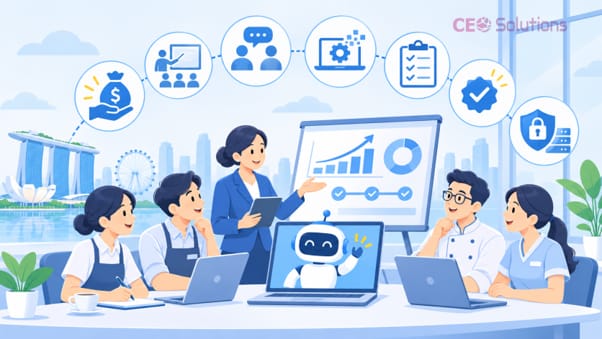
Singapore has introduced initiatives to encourage businesses to adopt AI and improve their digital capabilities.
National AI Impact Programme
Announced in March 2026, Singapore’s National AI Impact Programme aims to support 10,000 enterprises in advancing their AI adoption over three years.
The programme forms part of the country’s efforts to help businesses and employees develop practical AI capabilities.
Businesses can also refer to IMDA’s AI for Enterprise Impact Playbook, which provides a structured approach to identifying needs, matching solutions and taking action.
Enterprise Singapore’s EDGE Grant
The EDGE Grant was introduced on 30 September 2026, replacing the earlier Productivity Solutions Grant, Enterprise Development Grant and Market Readiness Assistance schemes for new applications.
It provides support for eligible business improvement activities, including automation and digitalisation.
However, not every AI subscription or technology project automatically qualifies for funding.
Businesses should review the latest eligibility requirements, supported activities and application conditions before making financial commitments.
AI Workshops and SME Advisory Support
Enterprise Singapore also offers practical learning opportunities through its Driving Entrepreneurship with AI workshops.
These workshops help smaller businesses explore how AI can support activities such as marketing, customer service and daily operations.
Business owners can also approach SME Centres for guidance on business improvement and suitable support programmes.
Conclusion: Start Small and Build Your AI Capabilities Gradually
AI adoption does not have to begin with a major investment or a complete change to your business operations.
For service-based businesses in Singapore, the most practical approach is to identify an existing problem, select a suitable AI tool and test whether it delivers measurable improvements.
Employees should receive appropriate training, customer information must be protected and important decisions should remain under human supervision.
While AI can support marketing and content creation, building a strong online presence still requires a clear SEO strategy, helpful website content and an understanding of what potential customers are searching for.
By combining suitable AI tools with effective business and digital marketing practices, Singapore SMEs can improve their daily operations while building a stronger foundation for long-term online visibility and customer engagement.
Frequently Asked Questions
Not necessarily. Costs depend on the type of software, its features and how extensively it is used.
Some businesses can begin with affordable subscription-based tools or existing software that includes AI functions.
However, the total cost should also include staff training, implementation and ongoing maintenance where applicable.
Many ready-made AI tools are designed for everyday business users and do not require advanced technical knowledge.
Business owners and employees still need sufficient training to use these tools correctly and understand their limitations.
More complicated systems may require assistance from qualified technology providers.
AI can assist with repetitive activities, but it cannot reliably replace every aspect of human service.
Customer relationships, professional judgement, problem-solving and sensitive decisions often require personal attention.
For many service-based businesses, AI is most useful when it helps employees work more efficiently rather than removing human involvement.


